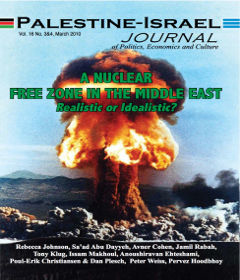
Editorial
-
The Steps to Be Taken Before It Is Too Late ( )
By Ziad AbuZayyad
Vol. 16 No. 3 2010
Focus
-
Israels Nuclear Future: Iran, Opacity and the Vision of Global Zero
( )
When facing the Iranian nuclear challenge, it is time for Israel to think “out of the
box.”
By Avner Cohen
Vol. 16 No. 3 2010
-
Iranian Perspectives on the Global Elimination of Nuclear Weapons
( )
Glimmers of hope exist given the U.S. administration’s commitment to find a
negotiated solution and Iran’s nuanced responses to international pressures and offers
of negotiations.
By Anoushiravan Ehteshami
Vol. 16 No. 3 2010
-
Palestine and the Nuclear Non-Proliferation Treaty ( )
In examining the impact of the Israeli and Iranian nuclear positions on the Middle East
and the Palestine-Israel conflict, in particular, it is in the interest of the Palestinians as
part of their quest for statehood to have a clear position in favor of the NPT.
By Jamil Rabah
Vol. 16 No. 3 2010
-
Israel’s Nuclear Armament ( )
Israel’s official and unofficial positions regarding nuclear arms and the reasons and
motives behind Israel’s policy of ambiguity.
By Sa’ad AbuDayyeh
Vol. 16 No. 3 2010
-
Meeting the Iranian Challenge
( )
The best way for Israel to combat the perceived Iranian threat is to embrace the Arab
Peace Initiative, do the two-state bargain with the Palestinians and conclude a deal
with Syria.
By Tony Klug
Vol. 16 No. 3 2010
-
The Iranian Factor in the Arab-Israeli Conflict ( )
The Iranian issue should be dealt with as a challenge that could pave the way for
strategies that lead to a sustainable Middle East peace and to stability in the region.
By Walid Salem
Vol. 16 No. 3 2010
-
Disarmament Education and Epistemic Community: A Weapons of Mass Destruction- Free Zone in the Middle East
( )
A discussion about the dilemmas and debates surrounding the Middle East Weapons
of Mass Destruction Free Zone (ME WMDFZ) and potential ways forward.
By Poul-Erik Christiansen
and Dan Plesch
Vol. 16 No. 3 2010
-
The 2010 NPT Review and the Middle East: Challenges and Opportunities ( )
The NPT Review Conference this year is an excellent opportunity to revitalize crucial
efforts to reach the aim of Nuclear Zero in the Middle East.
By Sameh Aboul-Enein
Vol. 16 No. 3 2010
-
Can the Islamic Bomb Become a Reality? ( )
The possibility of Muslim countries possessing nuclear weapons and what that would
signify on a global scale.
By Pervez Hoodbhoy
Vol. 16 No. 3 2010
-
From an Old Nuclear Order to a New Anti-Nuclear Order
( )
The ideology behind the old nuclear order is becoming obsolete, and a new initiative
toward a nuclear-free world is crucial for any peaceful solution in the Middle East.
By Issam Makhoul
Vol. 16 No. 3 2010
-
Peace, Law and Nuclear Weapons (As Seen by Two Jews and an Arab
( )
International legal opinion says that nuclear disarmament will remain the ultimate goal
of al1 action in the field of nuclear weapons.
By Peter Weiss
Vol. 16 No. 3 2010
-
Nuclear Disarmament Initiatives in the Run-Up to the 2010 NPT Review Conference
( )
An overview of recent disarmament initiatives at the onset of the Nuclear Non-
Proliferation Treaty’s 2010 Review Conference and the challenges in light of possible
Middle East proliferation.
By Rebecca Johnson
Vol. 16 No. 3 2010
-
Creating an Anti-Nuclear Movement in Israel
( )
A nuclear war would produce dire consequences for the Middle East, making the
organization of a grassroots anti-nuclear movement a key priority.
By Sharon Dolev
Vol. 16 No. 3 2010
-
The Nuclear Trap ( )
The best solution for the anxiety in Israel about nuclear developments is a total nuclear
disarmament in the region.
By Boas Evron
Vol. 16 No. 3 2010
-
The Nuclear Option and Peace in the Middle East
( )
Israel’s nuclear option is not any less dangerous than Iran’s, but comprehensive peace
will bring an end to Israeli and Iranian nuclear claims.
By Ziad AbuZayyad
Vol. 16 No. 3 2010
-
No More Holocausts
( )
Looking back at Auschwitz and Hiroshima, looking forward towards a nuclear-free
Middle East.
By Hillel Schenker
Vol. 16 No. 3 2010
-
Iran, Israel and the U.S.: Resolving the Nuclear Impasse
( )
By Richard Silverstein
Vol. 16 No. 3 2010
Viewpoint
-
The Nuclear Threat: Israelis and Palestinians Are Doomed to Live or Die Together ( )
Someone will have to take the lead in the dance of diplomacy that Israel and Palestine
are engaged in.
By Mubarak Awad
and Edy Kaufman
Vol. 16 No. 3 2010
-
From the Margins to the Mainstream: Impact of Extreme Religious Discourse in Israel ( )
Extreme statements by religious authorities reflect a movement from a border-based to
an ethnic conflict.
By Menachem Klein
Vol. 16 No. 3 2010
-
Arabic Language and Culture in Israel Could Be an Object of Pride, but Is Not ( )
The sidelining of Arabic in Israeli culture is a loss for the entire nation.
By Torkel Lindquist
Vol. 16 No. 3 2010
-
IAEA Resolution on Implementation of NPT Safeguards Agreement in Iran ( )
Vol. 16 No. 3 2010
Book Review
-
Water Resources in the Middle East: Israel-Palestinian Water Issues - From Conflict
to Cooperation ( )
edited by Hillel Shuval and Hassan Dweik.
By Olli Ruohomäki
Vol. 16 No. 3 2010
-
My Happiness Bears No Relation to Happiness: A Poet’s Life in the Palestinian Century
by Adina Hoffman. ( )
By Mya Guarnieri
Vol. 16 No. 3 2010
Culture, Literature and the Arts
-
The End of Spring ( )
Excerpts from Sahar Kalifeh’s very human novel The End of Spring about the
Palestinian struggle during the 2002 siege of Yasser Arafat’s Ramallah headquarters.
By Sahar Khalifeh
Vol. 16 No. 3 2010
Documents
-
UN General Assembly Resolution A/RES/63/38 ( )
Establishment of a Nuclear-Weapon-Free Zone in the Region of the Middle East
Vol. 16 No. 3 2010
-
UN General Assembly Resolution A/RES/63/84 ( )
The Risk of Nuclear Proliferation in the Middle East
Vol. 16 No. 3 2010
-
NPT/CONF.2010/PC.I/WP.28 ( )
Implementation of the resolution on the Middle East adopted by the 1995 Review and
Extension Conference of the Parties to the Treaty on the Non-Proliferation of Nuclear
Weapons Submitted to the Preparatory Committee for the 2010 Review Conference by
Oman on behalf of the League of Arab States.
Vol. 16 No. 3 2010
-
Israeli Grassroots Anti-Nuclear Movement, 2009-2010 ( )
Prepared by Sharon Dolev
Vol. 16 No. 3 2010