

7 October 2023 did not start on 7 October 2023 1
In October 1972, my treatise, “Middle East Conflict: a tale of two peoples,” which called for a Palestinian state on the occupied territories of the West Bank and Gaza Strip alongside Israel, was due to be issued as a pamphlet by a leading British think tank2. So convinced was I that this was the only logical way of resolving the conflict that when the date was pushed back three months to January 1973, I protested that by then the idea might already have been put into effect! As it turned out, I needn’t have worried.
I was then a rookie writer in my twenties. Now in my early eighties with countless articles, pamphlets, talks, peace proposals, consultancies and other interventions behind me, I have never wavered from the view that either the Palestinians will have their own independent state next to Israel or there will be indefinite conflict. And here we are. The reasoning today is essentially no different from the reasoning then: that, to be plausible (the primary test), any proposed solution must meet the minimum core aspirations of the principal protagonists. Failing this, the denied party or parties will be certain to sabotage the envisaged outcome. The question then is what are those minimum core aspirations? An empathetic review of the two histories and the respective narratives – which I endeavoured to expound in my 1973 pamphlet – leads inexorably to the conclusion that for both peoples it is self-determination in their own state in the country that each claims as its own (regardless of the “objective” merits or demerits of the respective claims).
The Two-State Idea Needs to Be Refreshed and Updated
Decades on, however, the shape and character of the two-state vision needs to be refreshed and updated to accord with the changed physical, political and demographic circumstances. A more apt model today may be the 1993 division of Czechoslovakia – once a unitary secular democratic state - into the Czech Republic and Slovakia. This was a peaceful transition based not on enforced population transfers, but on mutually agreed jurisdictions, with open borders and free movement. It was about political sovereignty over demarcated territory, not ethnic purity. An outcome along these lines may be a means of restoring the original conception of two neighbouring states as a catalyst to bring the two peoples closer together on a basis of parity, not as a way of rigidly separating them (“we here, them there”), as a distorted version of the idea proclaimed in later years.
In practice, there may be a supplementary need for minor equitable land swaps, based on the 1967 borders, coupled with time-limited compensation for wayward Israeli settlers plus a firm deadline for the withdrawal of the Israeli army – the protector of the settlers – from the territory. There may even be a potential for a future Israeli-Palestinian confederation or, more sustainably, an Israeli-Palestinian-Jordanian confederation (with safeguards against it being an Israeli-Jordanian condominium over Palestine). A future template could be Benelux, comprising the sovereign states of Belgium, the Netherlands and Luxembourg. This might sound over-ambitious, but it is easily forgotten that wars, invasions and annexations marked the common history of these three countries in the past. No progress along these lines will be possible, however, for as long as Israel is governed by a fusion of messianic zealots and ultranationalist fanatics, strung together to keep a desperate prime minister in power and out of jail. So, barring a military coup, an urgent focal point for outside action and pressure needs to be the Israeli electorate, bearing in mind that the next Israeli election is scheduled for 2026.
All That Has Happened Was Not Inevitable
The main theses of this current article are that the terrible things that have occurred in recent times were not inevitable, and that without swift, belated, decisive, outside action things will go from worse to worse.
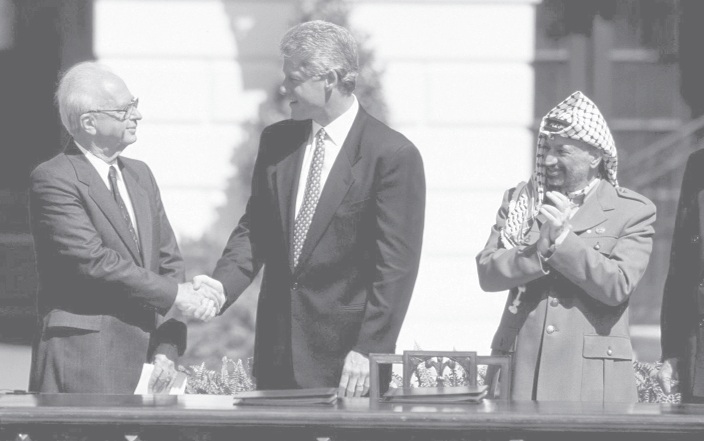
For decades past, the future direction was in the balance. There was a time - during the upbeat phase of the Oslo peace process in the early 1990s - when the omens for Israeli-Palestinian peace appeared to be favourable. Palestinian flags flew proudly in West Bank towns and villages (with Israeli acquiescence), the Palestinian street was buoyant at the prospect of imminent independence, co-operative activities between individual Palestinians and Israelis and between Jews, Arabs and Palestinians in other countries were fostered, and would-be peacemakers from South Africa and Northern Ireland visited seemingly successful Israeli and Palestinian peacemakers to pick their brains. Concurrently, international research institutes observed a global decrease in antisemitic and Islamophobic incidents. In the course of time, however, what distinguished the Israeli-Palestinian conflict from South Africa, Northern Ireland and the Cold War, is that it alone outlived the century that had nurtured it and staggered into an already over-burdened twenty-first century, where it now appears to be lost in a timeless wilderness.
While the murderous Hamas assault of 7 October 2023, was profoundly shocking, it was hardly surprising. For many Jews in Israel and around the world, the killing and abduction of so many of their number was viewed through the lens of the Nazi Holocaust and the history of antisemitic pogroms in Europe. It revived all their worst fears, traumas and insecurities. This framing, while understandable, seriously misses the point. For decades, many analysts had warned of a seismic explosion; for no people will bear a stifling military occupation forever. Hamas had choices that day and nothing can justify the horrific choice it made (the same may assuredly be said of the Israeli government’s devastating response), but it is important to understand that, from the Palestinian standpoint, it was the occupation - not antisemitism - that framed the context for that fateful October day.
Two Conflicting Currents After 1967
In the aftermath of the Arab-Israel war of 1967 a battle between two conflicting currents was ignited. Current A - practically invisible at first - inclined towards resolving the conflict on the basis of mutual acceptance and a comprehensive regional peace, rooted in self-determination for both Palestinians and Israelis in neighbouring states. Current B – also barely perceptible to begin with — trended in the opposite direction, towards the occupying power expropriating and colonizing occupied land and denying independence to the occupied people. Both currents gathered pace as the years went by. The one that eventually prevailed would determine the future.
With regard to the Palestinians, there was little evidence initially – whether in Israel, the Arab world or internationally - of support for Current A. Indeed, the authoritative UN Security Council Resolution 242 of November 1967, failed even to mention the Palestinian people by name. The only allusion to them was the need to achieve “a just settlement of the refugee problem,” depicting them entirely as homeless refugees and not in any sense as a stateless nation. The rest of the resolution was about principles affecting the needs and interests of established states.
A principal author of SCR 242, Lord Caradon, explained to me in conversation in 1977, that no one involved in the drafting of the resolution had raised the question of the Palestinians being regarded as a people entitled to self-determination or their own state. However, attitudes were slowly transforming and he had himself largely changed his own mind. Subsequently three Israeli prime ministers, Yitzhak Rabin, Ehud Barak and Ehud Olmert – initially hardliners - underwent epiphanies while in office and were edging towards accepting a Palestinian state in some form alongside Israel. It is hard to say where their journeys would have ended had they not, respectively, been assassinated, defeated and imprisoned. Under the Oslo Accord of 1993, Israel recognized the PLO (and the PLO recognized Israel). Opinion polls conducted in the early 2000’s found that over 70 per cent of Israelis (and roughly the same percentage of Palestinians) supported a two-state outcome based on the 1967 borders.
These developments, among others, were significant indicators of the steadily evolving global mood – including within Israel - which eventually produced UN Security Council Resolution 1397 in March 2002, affirming “a vision of a region where two States, Israel and Palestine, live side by side within secure and recognized borders.” While the resolution was momentous, it had taken a full 35 years for the right of the Palestinians to statehood to be acknowledged. In the interim, many promising opportunities had been forfeited and new obstacles erected.
For Israel too, its acceptance as a legitimate state by the region in the aftermath of the June 1967 war was no less dismal, with the Arab League summit in Khartoum in September of that year unanimously declaring no peace, no recognition and no negotiations. But again, the mood steadily changed as the years progressed. Indeed, with the benefit of hindsight, the three definitive “noes” may be better understood as three conditional “yesses but not yet.” The Arab world had been stung by its humiliation on the battlefield, but having twice sought Israel’s elimination and paid a heavy price on both occasions, it shifted, at different paces, to alternative strategies, with Egypt in the vanguard - starting in 1977 with President Sadat’s visit to Israel - followed a decade later by the PLO and then Jordan. Despite its hostile rhetoric, Syria periodically put out strong peace feelers, and several other Arab states developed lower-level or clandestine relations with Israel over the years.
The transformation was again completed in March 2002, when the Arab League unanimously adopted the Arab Peace Initiative - subsequently endorsed by the 57-member states of the Organization of the Islamic Conference - which called for comprehensive peace with Israel by all Arab states contingent on the establishment of a Palestinian state on the West Bank and Gaza Strip with East Jerusalem as its capital (as well as an “agreed upon” resolution of the Palestinian refugee problem). A huge distance had been travelled by the Arab world since 1967. It would not be a stretch to say that by 2002, both the Palestinians and Israel had effectively won their principal battles – for international acceptance of the right to statehood in the one case and for regional acceptance as a legitimate state in the other case.
Current A, however, did not have the field to itself. Simultaneously, Current B had been advancing in the form of spreading Jewish settlements throughout the West Bank, physically chopping up the territory and effectively annexing chunks of it. These ominous developments were no more expected, however, at the conclusion of the 1967 war than were either strand of Current A. The Coordinator of the Occupied Territories, General Shlomo Gazit, explained to me in August 1973, that following the lightning military victory, “everyone thought that Israel would return to the 1967 borders” under great-power pressure, as it had been forced to do in 1957 following its swift capture of the Sinai peninsula the previous year. So, there was a determination, he said, to use the limited time available to create certain facts on the ground, mainly around the border areas for security purposes, and a change in Palestinian attitudes towards Israel. But the anticipated international pressure never materialized. Destiny may have unfolded quite differently had external powers not been so negligent or indulgent from the outset.
A Disastrous Race to the Bottom
With the bombshell election of “Greater Israel” ideologues under the right-wing Menachem Begin in May 1977, following the fiasco of the 1973 war under Labour, the brakes came off and the project to cover the entire West Bank with Israeli civilian settlements - which had been tightly controlled at first - began in earnest, with the ultimate intention of annexing the territory. A few months before the election, Begin told me that Judea and Samaria, as he called the West Bank, was the “beating heart” of the Jewish people. Under his future government it would be retained forever, he said, for historical, national and religious reasons, regardless of any future outside pressure. Fast forward 45 years to 2022, and the truly loopy right finally managed to get a firm grip on the levers of government aided by Israel’s idiosyncratic voting system. Now, while the window is still open, they are going for broke, with the implicit - in some cases explicit - intention to make life insufferable for Palestinians to impel them to flee.
If this thrust is not sharply reversed, the future looks bleak, not just for the Palestinians but for Israelis and Israel too. And not just for them. Jews around the world are experiencing an unprecedented surge in global anti Jewish sentiment3 fuelled by the actions of a state that loudly and proudly insists it be recognized as Jewish and whose toxic prime minister avows that he acts in the name of Jews everywhere. He has no right or mandate to make this claim. That many Jews are prominent in the international protests against Netanyahu and his government’s mounting atrocities speaks for itself.
There are no winners in this conflict (as evidenced by an upsurge in Islamophobia and anti-Arab sentiment too4). When either party proclaims it has been victorious in some way; it is only because of the common tendency to frame their ostensible advances in terms of the setbacks to the other. By any other measure, the two peoples have for long been in a disastrous race to the bottom, for which Israel’s expansionist propensity and loathsome conduct in recent times bear the principal responsibility. This said, the zealous Islamic organization Hamas – initially a product of the occupation and for years subsidised by Qatar with the connivance of the Netanyahu government - has been a curse on the Palestinian people for provoking, whether intentionally or naively, the outrageous Israeli response. Time will tell whether the survivors of Gaza will ever forgive the group.
On Israel’s part, it’s almost as if its government had gathered together the most odious accusations ever made against the state and treated them as a “to-do” list. In denying or justifying almost every accusation, Netanyahu habitually plays the antisemitism card. But falsely accusing people of this heinous crime - which has been responsible for the mass murder and persecution of millions of Jews – fools almost no one. Smearing people whose allegiance to universal human rights does not stop at the Palestinian doorstep cheapens and degrades the meaning of antisemitism, casting doubt on the credibility of the accusation even when it is justified.
But why should Netanyahu and his crazy messianic friends care about such triflings? While Israel has a right – indeed a duty – to defend its citizens, it is not clear what it means to have a right to defend itself against a people it is occupying, as its international supporters frequently assert. The only way that Gaza, or for that matter the West Bank, will never again be a threat to Israel is to end the occupation and engage in a process of reconciliation. Once the basic structural relationship is put right, even the strongest emotional attitudes can fade in the course of time, as witness French-German relations.
The World Needs to Go for Broke Too
For now, to combat the madness, the rest of the world needs to go for broke too. Universal recognition of a Palestinian state without further delay will send a solid message to the Israeli public that the international community will not countenance a future that does not include a Palestinian state alongside Israel. But this is not sufficient. Vitally, it needs to be backed up by relentless pressure at every level until Israel gets the message, replaces its government and radically changes its orientation. This will determine whether Current A or Current B ultimately prevails.
In sum, 7 October 2023 - did not start on 7 October 2023, which is why the world doesn’t have the luxury to duck the main issues any longer.
_____________________________________________________________________________________________________
1 This article is an adapted extract from my soon-to-be-completed book, “Lost in the 21st century?”
2 Young Fabian pamphlet 32, January 1973.
3 https://www.visionofhumanity.org/gaza-conflict-leads-to-rise-in-antisemitism-and-islamophobia/
4 https://www.nbcnews.com/news/us-news/arab-american-history-month-2024-rcna146874