

I. Introduction
Looking at the global map, Europe stands out as one of the few remaining actors that have not yet recognized the State of Palestine. Though 10 out of 27 member states of the European Union have done so throughout the past four decades, its central European heavy weights have refrained from recognition. In light of the ongoing and ever worsening atrocities since October 7, this is now beginning to change.
France, as the first permanent member of the UN Security Council and G7 country, is set to recognize the State of Palestine in September at the upcoming UN General Assembly summit that aims to revive global momentum for a two-state solution. Belgium and the UK announced conditionally that they would follow suit. In principle, all EU member states continue to endorse the two-state-solution. In July, the EU signed the New York Declaration ahead of the September conference, affirming a shared commitment to the establishment of a sovereign and democratic Palestinian state.1
Yet, EU member states remain divided regarding whether recognition ought to come at the beginning, or the end of a negotiated peace process. Despite hardening rhetoric in the past months, important players, such as Germany and Italy, continue to insist on the latter. This inner EU schism regarding recognition is indicative of broader disagreements when it comes to taking decisive and concerted EU policy actions towards Israel. The recognition of Palestine may be regarded as one of the “softest” policy tools European states have in their tool kit, as it is largely symbolic and does not directly exert pressure on Israel as, for instance, sanctions or halting of weapon exports would. When considering these questions, EU states largely follow their own internal logic driven by national interests and geopolitical alliances.
This article thus aims to juxtaposing the largely symbolic act of recognition with the realities on ground that Israeli and Palestinian civil society is navigating. It analyses the potential of the Saudi-French initiative and looks at the role of Europe to assure that recognition will not become an end in itself but a precursor to a robust roadmap capable of revitalizing the two-state peace process. It further examines the relationship of European governments and civil society in Israel and Palestine in reviving the peace process.
We also elaborate on the relationship of European governments and civil society in Israel and Palestine in reviving the peace process.
Much of the background information and insights presented in this article have been gathered during a series of meetings, workshops, roundtables, and focus group meetings between Palestinian and Israeli peacebuilding actors and European opinion leaders and policymakers in various EU capitals throughout 2025. These encounters were organized under the EU-funded trilateral dialogue initiative EPICON (European Palestinian-Israeli Dialogue). By engaging civil society participants from both Israel and Palestine, discussions explored issues such as the recognition of the State of Palestine within the framework of the French-Saudi initiative, the role civil society should play in it and what Europe can do to lend renewed support towards a two-state solution.
II. Sharing the Burden for Peace: The Intersection of Governments and Civil Society
2.1 The Saudi-French Initiative
While the overarching goal of the Saudi-French initiative is to revive the Israeli-Palestinian peace-process, the challenges are manifold. This has become quite evident given the ever-changing timeline. The initiative was first announced by French President Macron in December 2024. Yet, one week before a planned declaration of the initiative in June 2025 at the UNGA, Israel launched its war on Iran. Citing logistical and security reasons that would prevent Palestinian President Mahmoud Abbas from attending the event, President Macron postponed the June meeting. It eventually took place in New York on July 28th and 29th.
The goals and strategy of the initiative can be described in four principles: (1) Full recognition of Palestine, (2) regional integration and normalization with Israel if the peace-process is implemented, (3) the exclusion of Hamas from any post-war scenario and (4) the reform of Palestinian governance.2 Under the pressure of both French President Macron and Saudi Crown Prince Mohammed bin Salman, in March 2024, President Abbas declared that new elections to the Palestinian National Council would be held and reforms implemented. Unlike the Palestinian leadership, Israel has not endorsed the initiative.
The Outcomes Statement at the end of the rescheduled conference known as the New York Declaration, delivered on July 30, 2025, says that Saudi-Arabia, France and 17 other countries have “committed to taking tangible, time-bound, and irreversible steps for the peaceful settlement of the question of Palestine.”3 However, whether this initiative will evolve into a long-term, sustainable peace process remains uncertain, hinging largely on the international community’s response and the willingness of governments to exert political pressure on first and foremost Israel but also the PA.
Europe’s Limited Involvement
The initiative consists of eight working groups, where different countries give their advisory opinion and input. While important stakeholders such as Egypt, Jordan, Qatar, are part of the working groups, the main allies of Israel such as the U.S., Germany but also India have not joined the initiative. Other big international players such as Russia and China have not joined the initiative either.
From the European countries Great Britain, Norway, Ireland and Italy are part of the working groups. This means that Italy and Ireland are the only EU-member states that have joined the initiative, which explains the rather weak and informal collaboration between the European Union and the Saudi-French initiative. The fact that Italy is actively part of the working groups must be seen positively. Its official position is that the recognition of Palestinian statehood comes after successful peace negotiations between Israel and Palestine.4 The Italian contribution to the initiative therefore diversifies the group of countries trying to revive the Middle East peace process.
On the other hand, the initiative has clear deficiencies: As of now, there is no clear outline, timeframe or accountability mechanisms for actionable steps towards a two-state solution. The absence of those countries that hold most political leverage on Israel limits its potential. This is especially true concerning the U.S., Israel’s most important ally, which has actively opposed the French-Saudi plan. The biggest blow from the U.S. came in the end of August when the Trump administration revoked the U.S. visas of Palestinian President Mahmoud Abbas and 80 other Palestinian officials to prevent them from attending the New York UNGA conference in September where recognition of a Palestinian state is scheduled to be declared by France, Belgium, the UK, Canada, Australia and other countries.5
2.2. Involvement of Israeli and Palestinian Civil Society
In an unprecedented approach, the Saudi-French initiative aims to advance the Middle East Peace Process through both multilateral engagement and civil society inclusion. The EU and those member states that consider recognition of Palestine as part of revitalizing the Middle East Peace Process, should actively work to engage civil society on both sides. While President Mahmoud Abbas officially welcomes the initiative, significant challenges regarding the full integration of the PA into the process remain. Given that the initiative envisions reforming the PA, institutionalized cooperation with Palestinian civil society is essential. In Israel, where the government opposes a Palestinian state; civil society remains a one of the only partners left for dialogue and practical cooperation.
The Paris Peace Forum as a Catalyst for Civil Society Engagement
In 2024, in an important turning point, G7 leaders formally recognized the centrality of civil society to the viability of a two-state solution. This was operationalized at the Paris Peace Forum in June 2025, hosted under the patronage of President Macron and ahead of the UN High-Level Conference on the Israeli-Palestinian conflict. Hundreds of Israeli and Palestinian civil society organizations, convened by the Alliance for Middle East Peace (ALLMEP), delivered five cross-cutting policy recommendations that were subsequently integrated into the New York Declaration — an important attempt to align civil society insights with political decision-making. These recommendations focused on: (1) ending the war in Gaza; (2) establishing a comprehensive regional security framework; (3) recognizing Palestinian statehood as a first step toward peace while supporting PA governance reform, democratic leadership, and security guarantees to Israel; (4) creating an internationally-backed peace fund to scale civil society efforts, and (5) investing in reconciliation, education, and new narratives, with civil society at the core.6
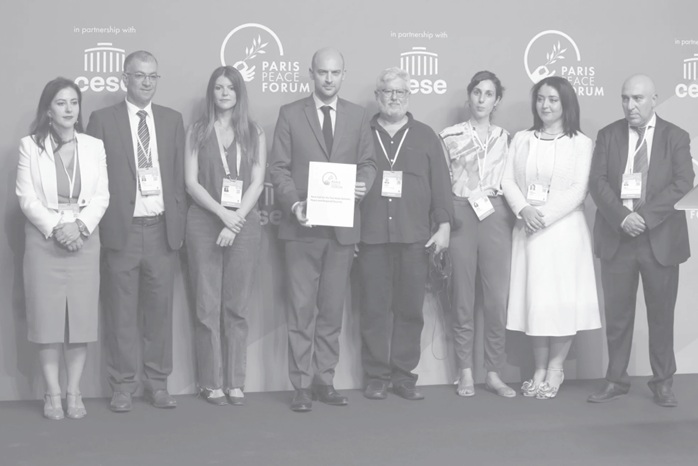
While ALLMEP, as representative of 180 Israeli and Palestinian civil society NGOs, views the integration of civil society into political decision making as an important meta goal, its director John Lyndon emphasizes that such recommendations risk remaining symbolic unless matched with genuine diplomatic pressure and a robust, process-oriented roadmap that goes beyond the mere symbolism of recognizing Palestinian statehood. According to him, the French-Saudi initiative’s unprecedented multilateralism offers unique potential: “One of the beauties of multilateralism is that different actors can own different parts of the strategy, and the whole becomes greater than the sum of its parts. It would be foolish to suggest that the GCC (Gulf Cooperation Council) countries should own the civil society piece because they are not free democratic societies. They naturally look towards economic investment and reconstruction. Europeans, on the other hand, should lean heavily into the civil society dimension by over-investing, over-integrating, and insisting on its inclusion.”7
Israeli Government’s Reaction
Given the increasingly shrinking space for peacebuilders and advocates of a two-state solution, developing a robust, consequence-based roadmap under the French-Saudi initiative seems more urgent than ever. The Israeli government has been quick to take steps widely perceived as direct countermeasures to the growing EU recognition of Palestinian statehood. The approval of the construction in the long-contested E1 corridor East of Jerusalem — opposed for decades, amongst others, by Israel’s most important ally, the U.S. — illustrates this dynamic. E1 is especially controversial because it would essentially sever the West Bank into two separate parts. Israel’s far-right Finance Minister Bezalel Smotrich stated the plan would make a two-state solution impossible by dividing any Palestinian state and restricting Palestinian access to Jerusalem. 8
The UK, France, and 19 other countries signed a joint statement condemning the move as “unacceptable and a violation of international law,” urging its immediate reversal.9 According to John Lyndon, “every time the international community signals meaningful action, Israel responds with preemptive or retaliatory measures — turning pressure itself into a negative dynamic. This shows why recognition alone is nowhere near sufficient without a broader strategy.”10
In Israel, where the two-state solution and the occupation have largely vanished from political and societal discourse over the past two decades, the government has dismissed the French-Saudi initiative as a “reward to Hamas.”11 This ignores the fact that its broader framework incorporates mechanisms to exclude and disarm Hamas, reform and democratize the PA, and ensure Israel’s regional integration, as first outlined in the 2002 Arab Peace Initiative. These provisions are clearly in Israel’s long-term interest, but are strategically overlooked by its leaders in favor of blocking recognition of Palestinian statehood.
Meanwhile, Israeli civil society organizations face mounting threats. A proposed NGO bill would impose a 23% tax on donations—earlier drafts even proposed 80% — from foreign governments or entities such as the EU. Framed as a measure against “foreign interference” and groups accused of undermining Israel’s legitimacy, the law would in practice cripple many peacebuilding organizations that rely heavily on external funding. If passed, the legislation would deal a devastating blow to most, if not all, peacebuilding NGOs — also those that include shared Palestinian-Israeli partnerships.
Civil Society in Palestine
Operating under the daily realities of occupation, “for Palestinian civil society, the priority is to build resilience to help people remain on their land, withstand settler violence, and find economic stability.” says Nivine Sandouka, Regional Director of ALLMEP.12 The war has only heightened demand for humanitarian services while straining resources, leading some West Bank CSOs to step up cross-regional coordination with Gazan counterparts despite restrictions of movement between the West Bank and the Strip.
Despite these immense challenges, civil society in Palestine is among the most vibrant in the Arab world. The number of CSOs per capita is the highest in the Levant region, with CSOs in the West Bank playing a critical role in service delivery — health, education, legal aid — particularly where the Palestinian Authority (PA) is weak or absent. Yet, despite their expertise and community reach, these organizations are rarely included in formal decision-making. To counter this exclusion, some CSOs engage in “shadow policymaking,” producing alternative policy proposals on issues such as economic reform and gender equity, while also leveraging international partnerships — particularly with the EU and UN — to condition aid on reforms like anti-corruption and human rights compliance.
Still, their collective impact is hampered by fragmentation, donor driven competition, and PA securitization, which suppresses dissent. As Sandouka emphasizes, “CSOs seek legitimacy both from the grassroots and the Palestinian Authority, ensuring their work not only protects communities but also contributes to shaping the vision of a future Palestinian state in which they have a say in.” For the EU, strengthening these actors means not only funding service delivery but also protecting and politically empowering CSOs as legitimate stakeholders in governance reform and state-building.
2.3 Structural Deficiencies of Civil Society-Government Cooperation
The question of how governments can partner with civil society to advance both societal change and pressure the political leadership toward peace remains critical. While civil society plays a key role in shaping narratives of coexistence, presenting visions for a shared future, and providing essential services, their capacity is limited. This makes it even more important for governments to back up these actors politically. This is highlighted in a recent statement of the Association for Civil Rights in Israel, which expresses that “international pressure has proven to have an effect on those seeking to weaken human rights and democratic spaces,” and urge donor governments to oppose the NGO tax bill.13
Yet the limits of a divided EU once again become apparent: on the one hand, the Union responded to the NGO bill when High Representative Kaja Kallas announced at the “It’s Time” peace conference in Jerusalem in May 2025, that an additional €18 million would be provided to Israeli and Palestinian CSOs. On the other hand, when Kallas, in her role as Vice President of the European Commission, together with President Ursula von der Leyen, proposed partially suspending Israel’s participation in the Horizon Program, the initiative failed to gain unanimous backing among member states. Germany in particular argued that such measures would be counterproductive and risk undermining diplomatic efforts.14 In comparison, when Georgia, a non-EU candidate member state, adopted a similar law targeting CSO’s that receive governmental funding from abroad, the EU’s reaction was swift and harsh, effectively suspending the country’s EU accession process.15
Despite these organizations frequently calling for political pressure on the Israeli government, European funding and engagement with them do not automatically lead to the adoption of their recommendations.16 Instead, such engagement can sometimes allow political leaders to showcase dialogue and highlight quantitative funding goals, while deflecting real responsibility and political action.
III Conclusion
There is currently a real risk of losing vital civil society organizations in both Israel and Palestine, and foreign governments appear hesitant and ill-equipped to counter these developments effectively. This poses a serious threat to any potential nascent peace process, particularly as the Saudi French initiative advances only gradually with many obstacles in sight. If Israel and the U.S. continue to reject the initiative and local civil society actors lose existential funding, its impact could quickly evaporate.
Meanwhile, European governments remain divided over both the potential impact of the Saudi-French initiative and how far the European Union and its member states should go in deploying their political and economic leverage to first and foremost stop the war on Gaza, and secondly, to bring the Israeli government back on the table of peace negotiations.
Thus, without a robust roadmap that includes swift and effective measures, credible accountability mechanisms, and real consequences by the international community to deter actions that violate the process, recognition under the French-Saudi initiative risks becoming purely symbolic and, at worst, could accelerate the deterioration of conditions on the ground. Ultimately, recognizing Palestinian statehood must not become a pretext for governments to step back from applying their political leverage.
_______________________________________________________________________________________
1https://peacediplomacy.org/2025/08/09/the-palestinian-state-will-the-uns-two-state-summit-revive the-peace-process
2 Two-state solution conference poised to convene at UN as famine spreads in Gaza.
3 New York Declaration - France ONU.
4 Italian FM to Asharq Al-Awsat: Rome, Riyadh Share Goal of Middle East Peace (Asharq Al-Awsat) – Ministero degli Affari Esteri e della Cooperazione Internazionale.
5 US denies visas to Palestinian officials ahead of UNGA | The Jerusalem Post
6 https://drive.google.com/file/d/1FEY3WByhQlCWzZULl3UHwEeL5gtBeuXm/view
7 Interview 29.08.2025
8 https://www.diplomatie.gouv.fr/en/country-files/israel-palestinian-territories/news/2025/article/ joint-statement-of-foreign-ministers-on-e1-plans-21-august-2025
9 https://www.diplomatie.gouv.fr/en/country-files/israel-palestinian-territories/news/2025/article/ joint-statement-of-foreign-ministers-on-e1-plans-21-august-2025
10 Interview August 29
11 https://www.timesofisrael.com/mbs-attendance-at-2-state-confab-to-signal-that-france-will recognize-palestinian-state/
12 Interview August 29
13 See Association for Civil Rights in Israel, “NGO Bill Update,” July 2025.
14 https://www.spiegel.de/ausland/deutschland-will-israel-sanktionen-der-eu-nicht-zustimmen-a 8c4851a5-d1f1-4d94-ae93-0d3ab57e2867
15 EU halts Georgia's accession to the bloc, freezes financial aid over much-criticized law | AP News 16 https://www.regthink.org/wp-content/uploads/2025/02/The-Present-Day-2025.pdf