

Introduction
In Gaza, motherhood has never been simply a personal journey. For decades, the experience of bringing children into the world has been colored by occupation, siege, and recurrent wars. Yet, the ongoing war since October 7th, 2023, has pushed this reality into sharper relief: childbirth, once a private matter of family and medicine, has now become a political act. To give birth in Gaza today is to confront not only the pain of labor but also the collapse of hospitals, the terror of bombardment, and the uncertainty of whether one’s child will survive infancy under siege and fire.
This article explores how the war in Gaza has transformed reproductive life. It examines the medical crisis of pregnancy under fire, the psychological toll of motherhood in displacement, and the broader political dimensions of reproduction in a context where demographic survival is itself contested.
The Medical Crisis of Pregnancy Under Siege
The war has devastated Gaza’s already fragile healthcare system. According to UN reports, more than two thirds of hospitals have been rendered non functional due to bombings, fuel shortages, and lack of medical supplies. For pregnant women, this collapse has catastrophic consequences.
Doctors report a sharp rise in forced cesarean sections, often performed without adequate anesthesia or sterilization. Women arrive at makeshift clinics after days of displacement, dehydrated and malnourished, sometimes giving birth in tents or on the floors of overcrowded shelters. Miscarriages have spiked, with stress, hunger, and untreated medical complications contributing to fetal loss.
The right to safe pregnancy care — enshrined in international conventions — has become unattainable. For many women, reaching a functioning hospital is impossible, as bombed roads and military checkpoints block access. In some cases, laboring mothers have died en route. The act of delivering a child in Gaza is thus inseparable from the politics of war and siege.
Motherhood Amid Displacement and Trauma
Beyond medical dangers, women in Gaza carry the psychological weight of raising children in a war zone. Entire families live in crowded shelters with little privacy. Mothers nurse infants while listening to drones overhead, unable to promise their children safety or stability.
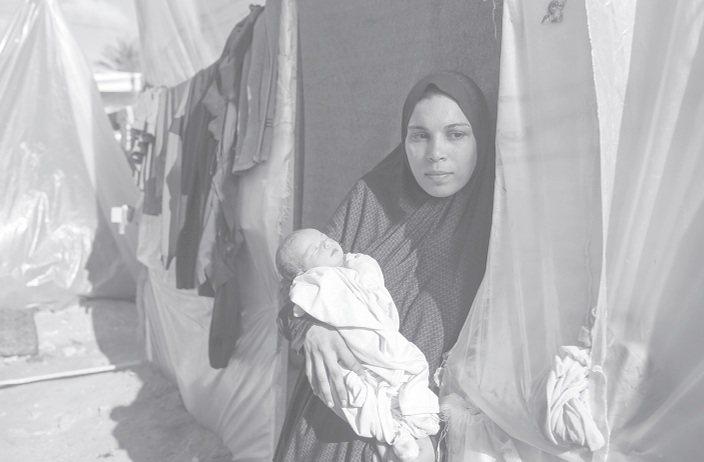
Displacement adds another layer of vulnerability. Women who have lost homes or relatives must parent while coping with grief and trauma. Some express guilt at bringing children into such a hostile world; others describe motherhood itself as an act of resistance, a refusal to let war dictate the end of their lineage.
Mental health experts note the rise of postpartum depression and anxiety in Gaza, often exacerbated by the unrelenting stress of war. Yet psychological services are almost nonexistent. For many mothers, survival means silencing their own fears to reassure their children, even as they themselves remain deeply scarred.
Reproduction as Political Resistance
In Gaza, reproduction is not a neutral act. Population figures are often politicized, cited in debates over the “demographic balance” between Israelis and Palestinians. Within this charged context, the decision to conceive — or to avoid pregnancy — takes on new meaning.
Some women view childbirth as a declaration of survival: every baby born is a defiance of attempts to erase Palestinian existence. Families sometimes speak of their children as “the future of Palestine,” framing reproduction as part of a broader struggle.
Yet for others, the idea of motherhood under siege provokes hesitation. Why bring children into a world of displacement, hunger, and bombardment? For these women, reproductive restraint is not surrender but an act of care, a refusal to expose children to inevitable suffering.
In both cases, birth is deeply political: whether as resistance, survival, or refusal, motherhood is shaped by the war’s ever-present shadow.
Voices of Women
To understand this reality, one must listen to women themselves:
• “I gave birth in a school shelter, with no doctor, only other women helping me. My son’s first cry mixed with the sound of airstrikes outside.” — A displaced mother from northern Gaza.
• “I lost two pregnancies during the war. I told myself maybe God is sparing me from raising children in this nightmare.” — A young woman in Rafah.
• “When I look at my baby, I see resistance. He is proof that we are still here.” — A mother in Khan Younis.
These voices illustrate the multiplicity of meanings attached to reproduction in Gaza — pain, fear, hope, defiance — all woven into the politics of war.
Legal and Human Rights Dimensions
International humanitarian law guarantees the right to health, including maternal care. The denial of safe pregnancy and childbirth services in Gaza constitutes not only a humanitarian crisis, but also a human rights violation. Organizations such as WHO and UNFPA have repeatedly warned that pregnant women in Gaza face life threatening conditions.
Furthermore, reproductive rights are recognized as fundamental under the Convention on the Elimination of All Forms of Discrimination Against Women (CEDAW), to which Israel is a signatory. By failing to ensure safe access to care, the conditions of war undermine these obligations.
Conclusion
In Gaza, giving birth is no longer just about bringing life into the world. It is about doing so in defiance of siege, amid the ruins of hospitals, under the weight of displacement and fear. Motherhood has become inseparable from politics, a site where survival, identity, and resistance intersect.
The politics of birth in Gaza reveal a profound truth: that even the most intimate human act — welcoming a child — cannot escape the reach of war. Here, motherhood is not merely private but collective, not merely biological but political. To give birth in Gaza is to stake a claim to existence itself.