

The Middle East stands at a decisive crossroads. The events of October 7, 2023, were not only a tragic eruption of violence but also a turning point that revealed, in stark terms, the competing policies, interests, and strategies of regional and global powers. At stake is nothing less than the future of one of the world’s most strategically significant regions: a region rich in natural resources, especially Eastern Mediterranean gas, and situated at the intersection of global trade routes.
For decades, the peoples of the Middle East have aspired to the simple right to live in dignity, security, and peace. Yet their aspirations have repeatedly been crushed by war, foreign domination, and projects of expansion. Today, two paths confront the region with dramatic clarity: either a descent into a militarized “Greater Israel,” sustained by domination, displacement, and endless wars, or the realization of a different vision — one of cooperation, justice, and a Palestinian state alongside the state of Israel, living in peace, harmony and mutual recognition, that anchors a stable and prosperous regional order. The question is urgent and unavoidable: which path will prevail, and at what price — human, political, and moral?
The Gaza Genocide and the Drive for “Greater Israel”
The devastation in Gaza since October 2023, has unfolded in full view of the world, amounting to more than genocide. It represents an assault on an entire people and a deliberate attempt to erase their future. Palestinians face the prospect of a planned mass expulsion: first from Gaza, then from the West Bank, while Jerusalem has already been largely Judaized and most of its Palestinian population forced behind the Apartheid Wall. If current trends continue, similar scenarios may soon extend into Sinai and Jordan.
Prime Minister Benjamin Netanyahu’s explicit commitment to a “Greater Israel,” backed by unyielding U.S. support and European paralysis, has emboldened this trajectory. Israel now exerts near-total control over historic Palestine. This expansionist vision is not new; it is enshrined in the Likud charter and reinforced by the 2017 Nation-State Law, which restricts self determination exclusively to Jews between the river and the sea, and potentially beyond.
Israel’s strategy is regional as much as it is territorial. Drawing on its military dominance in Lebanon and Syria, it seeks to fragment the Levant into sectarian enclaves, dominate Eastern Mediterranean energy resources, and control strategic trade corridors. Its alliances with actors such as Kurdistan, Azerbaijan, Cyprus, and Greece form part of a broader design for regional hegemony. Such a strategy ensures not peace but perpetual war — dividing the region into failed states and keeping it dependent, all sustained by U.S. and Western complicity.
The second phase of this expansion is already visible. Military operations in southern Lebanon and Syria are sowing instability across borders. Plans to occupy parts of Sinai and Jordan could follow, beginning with the forced displacement of Gazans. These military gains, celebrated by much of the Israeli Jewish public, reflect the embrace of Jewish supremacy over Palestinians and Arabs.
Yet such “victories” come at an immense cost. They are built on f lagrant violations of international law, disregard for signed agreements, and contempt for universal values. They also run against Jewish ethical traditions, as many Jewish scholars and leaders themselves affirm. The price is spiritual and moral as much as political: deep divisions within Israeli society and the Jewish diaspora testify to the crisis of identity and conscience provoked by this hegemonic project.
For Christians and Muslims alike, the images of destruction broadcast from Gaza in real time evoke profound dismay. The deliberate killing of civilians contradicts the moral legacy of the People of the Book, who once illuminated humanity with the Ten Commandments — foremost among them: “Thou shalt not kill.”
An Alternative Vision for the Region
In contrast to this destructive path, the peoples of the Middle East yearn for a future rooted in peace, security, and prosperity. This vision is not utopian. It has been articulated repeatedly: in the Palestinian Declaration of Independence of 1988, in the Arab Peace Initiative of 2002 endorsed by all 56 Muslim states, and in numerous global frameworks that recognize the necessity of Palestinian statehood.
The alternative is simple and just: Israel within internationally recognized borders, alongside a sovereign Palestinian state, in a region organized by cooperation, international law, and shared prosperity.
This vision is championed by Saudi Arabia, the Gulf States, the BRICS nations, and the wider Arab and Islamic world. It rests on the belief that the peoples of the region — far from being terrorists — are proud citizens, heirs of ancient civilizations, and contributors to humanity’s greatest achievements. This land was the cradle of civilization, birthplace of agriculture, alphabets, and law, and the home of monotheism. Its people include scientists, theologians, craftsmen, inventors, and statesmen whose legacies shaped the modern world. Reducing them to caricatures of violence, as in the distorted images of ISIS or Al-Qaida, is a profound injustice.
The appeal of this alternative is global. Around the world, popular movements, civil society organizations, and governments are increasingly aligned in solidarity with Palestinian rights and in pursuit of equitable peace. Even within the United States, a growing chorus questions the costs of unconditional support to Israel, urging a foreign policy that prioritizes American interests and domestic renewal over fueling endless wars. Among Jewish communities worldwide, too, debate grows louder over the moral and political price of militarized supremacy.
Gaza: A Crime That Cannot Be Ignored
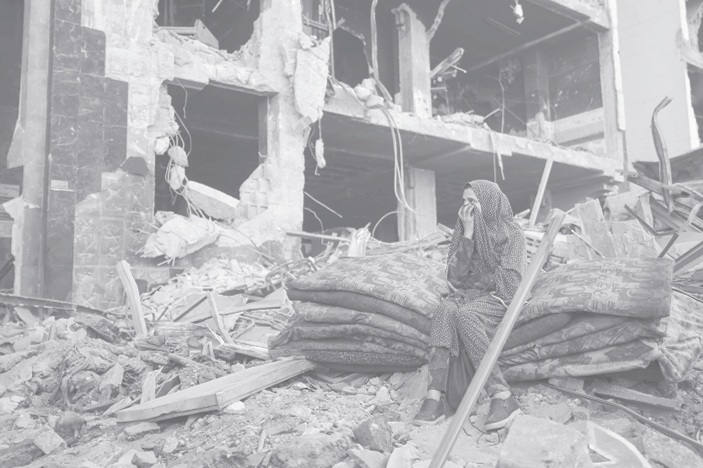
Before long-term visions can be realized, however, the immediate crisis of Gaza demands attention. For nearly two years, Palestinians have endured relentless bombardment, mass displacement, starvation, and systematic destruction of homes, schools, hospitals, mosques, churches, and universities. This suffering, live-streamed to the world, represents a crime against humanity on a scale that renders international law hollow.
The doctrine of the “Responsibility to Protect,” designed to prevent genocide and mass atrocities, has been exposed as meaningless by decades of impunity granted to Israel. Endless delays — semantic debates, empty resolutions, fruitless negotiations — have only enabled the carnage to continue. International courts affirm Palestinian rights, yet Western powers shield Israel from accountability. The double standard could not be clearer: democracy is invoked to justify power, not to defend human dignity.
Even more alarming are the plans being openly advanced in the shadow of Gaza’s destruction. What once seemed unthinkable — the Trump-era proposal to build a “Gaza Riviera” on the ruins of Palestinian lives — has been revived. Gaza’s natural gas reserves and prime Mediterranean coastline are being rebranded as investment opportunities, promoted by figures such as Tony Blair and Jared Kushner under U.S. sponsorship. This grotesque scenario envisions luxury and profit literally built on genocide.
If this vision is realized in Gaza, it is only a matter of time before similar schemes are imposed on the West Bank, where Palestinians already endure dispossession, settler violence, and daily repression. The crime in Gaza is thus not an isolated atrocity but a blueprint for wider displacement and erasure.
Signs of a Turning Point: Recognition of a Palestinian State
Despite the bleakness, there are signs of potential change. Recent declarations of the intention to recognize a Palestinian state by major European powers such as France and the UK at the UN General Assembly meeting in September mark a significant political moment. If these gestures are followed by concrete steps to establish a state before the land itself disappears under settlements, they could mark a turning point in history.
The Global Alliance for a Palestinian State, co-chaired by Saudi Arabia and France and grounded in the International Court of Justice’s rulings, offers a promising framework. Its success, however, depends on more than declarations. It requires detailed, funded plans, mechanisms for accountability, and reparations for decades of dispossession and ethnic cleansing. Crucially, it must avoid burdening Palestinians with debt while leaving Israel unpunished.
The ICJ has been unequivocal: the Palestinian right to self determination is unconditional. Efforts to make recognition contingent on Palestinian “reforms,” while Israel acts with impunity, betray the imbalance of power. Such conditionality risks reducing noble initiatives to hollow gestures, as Palestinians have seen repeatedly.
Lebanon offers a cautionary tale. International conditions demanding the disarmament of resistance movements without ending occupation have only deepened insecurity and internal division. Palestinians themselves have lived this dilemma since 2007, when internal splits between Hamas in Gaza and the PLO-led Palestinian Authority in the West Bank were exacerbated by external pressures. Unless Israel is compelled to respect agreements and international law, similar seeds of failure will be sown again.
Israel’s Rejection of Peace
Israel has made its position unmistakably clear: it rejects Palestinian statehood. The Nation-State Law of 2017, codifies this rejection, and subsequent legislation explicitly forbids the establishment of such a state. This policy, enshrined in the Likud charter and pursued since Netanyahu’s f irst government in 1996, has now hardened into law and practice.
Netanyahu has gone further, openly declaring a mission to realize “Greater Israel, according to some media reports, from the Nile to the Euphrates.” What once seemed mythical rhetoric is now advanced as practical policy, reinforced by military strength and global corporate alliances.
Israel’s boldness is rooted in power — its vast influence over U.S. and Western decision-making, the reach of pro-Israel lobbies, its integration into global corporate and financial networks, and its dominance of international media narratives, these lobbies go hand in hand with the messianic Evangelicals. These networks extend beyond governments to penetrate bureaucracies, coalitions, and markets. This infrastructure of influence explains why Israel’s violations proceed with impunity and why global responses remain paralyzed.
Two Conflicting Futures
The world is thus confronted with two starkly opposed futures:
1. Greater Israel – a hegemonic project based on perpetual war, military domination, economic exploitation, and expansion beyond Palestine into the wider region.
2. Regional Peace and Prosperity – a cooperative framework in which Israel coexists as a normal state within recognized borders alongside a sovereign Palestinian state, unlocking the cultural and economic potential of the region.
The first path promises instability, endless conflict, and moral decay. The second offers hope, grounded not only in ideals of justice but also in shared interests. Gulf investments, Eurasian partnerships, and regional cooperation could raise living standards across the region, turning it from a battlefield into a hub of innovation and prosperity.
Yet Israel stands alone in rejecting this solution, with only the United States under President Trump offering full support. Even this alliance may be fragile, sustained less by shared vision than by the coercive influence of Israeli lobbies and entrenched power networks.
The choice is now unavoidable. The recognition of Palestine, the rulings of international courts, and the rise of global solidarity movements provide opportunities to act. But time is short. If displacement, genocide, and endless war continue, peace may soon become impossible.
Conclusion
History has returned the Middle East to a decisive crossroads. On one side lies the project of “Greater Israel” — a vision of domination sustained by apartheid, war, and oppression. On the other lies the possibility of a just peace, rooted in international law and the equal dignity of all peoples.
The struggle is not only about the future of Palestine but about the future of the entire region — and indeed of the world’s moral order. The wave of solidarity, the recognition of Palestine, and the growing global rejection of genocide are signs of hope. Whether these are translated into meaningful action will determine whether the Middle East enters an era of perpetual conflict or opens the door to stability, prosperity, and shared humanity.
The choice is stark, and the time to act is now.