

There is a major paradox affecting American Jewish attitudes towards achieving a two-state solution (2SS) for the Israeli-Palestinian conflict. During the 2000’s, after the failure of the Oslo peace process (which itself avoided mentioning the 2SS!), it became the default position in the international community and of most mainstream American Jewish organizations, the far left and far right excepted, which generally prefer their own respective versions of a single state. Soon after this consensus settled in, however, a major potential problem arose as Israel moved away from the 2SS during Prime Minister Netanyahu’s second term (2009-13), although the U.S. and all major powers continued to strongly support it. This divergence did not present an immediate problem until recently because there was no expectation of any imminent attempt to actually resolve the conflict.
October 7, exacerbated everything, of course, including making long term solutions seem even more unattainable. It also badly shook up the already disunited perspectives of American Jews. The press delighted in highlighting “pro-Palestinian” or (even better) “pro-Hamas” Jews and contrasting them with “pro-Israel” Jews. The juxtaposition of demonstrators identified as members of Jewish Voice for Peace, an avowedly anti-Zionist organization often paired with Students for Justice in Palestine, contrasted with students affiliated with Hillel, a nominally apolitical but aggressively pro-Israel student organization, became a meme on many campuses during the academic year 2023-24. That said, there is no question that many American Jews, particularly those under 35, took another look at Palestinian demands and readjusted their stance, especially as anger at the far-right Israeli government grew. This process is still underway – and the New York Declaration announced at the end of the July conference at the UN and associated diplomatic moves hope to take advantage of it. The question is if that public is prepared and able to lend support to an effort that many continue to regard as eventual or even utopian.
I was able to find only two polls taken after October 7, that specifically asked American Jews about their opinion regarding the desirability of the 2SS. In an extensive poll on March 19, 2024, the highly respected and nonpartisan Pew Research Center asked respondents for their views on the “consequences of the Israel-Hamas War.” Forty-six percent of American Jews chose two states, 13% preferred “governed jointly,” 22% wanted only an Israeli state, and 17% “didn’t know.” Interestingly, these numbers were quite similar to the results for all U.S. adults (40%, 13%, 14%, and 30% with no opinion). Two percent of the U.S. adults wanted one Palestinian state, while less than 1% of the Jewish respondents chose that option.
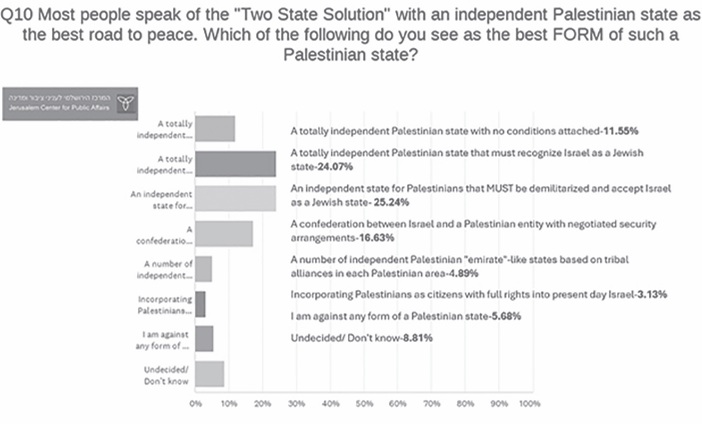
The reported response was very different in a survey taken only two months later, in May, 2024, by the right-leaning Jerusalem Center for Security and Foreign Affairs, with a question that focused on the “form” of the Palestinian state that the respondents (American Jews) preferred. Seventy-seven percent supported some form of independent Palestinian state next to Israel, including 16% who chose “confederation,” which implies a Palestinian state. (see graphic below). Fewer than 14% chose one of the three responses that negated any independent Palestinian state. Presumably the different forms of the questions asked explains the considerable disparity between the results in the two polls.
All surveys show a clear difference between views of Jews under and over 35, with the former far more skeptical of Israel on all indicia. The confusions are expressed in a New York Times column by Ezra Klein: “Why American Jews No Longer Understand One Another.”
What was often missing from the news photos and some of the reportage – perhaps because moderation seems ever so boring compared to radicalism – was the perspective on the Jewish side of the “pro-Israel left,” gathered in the Progressive Israel Network (PIN) which comprises the traditional peace organizations, including J Street, as well as the New Israel Fund, New Jewish Narrative (formerly Americans for Peace Now and Ameinu), T’ruah, and half a dozen other organizations, including my own, Partners for Progressive Israel (PPI), formerly affiliated with Meretz. We work by consensus as an informal network, and it can be anticipated that it will be from PIN organizations that support for two states and the current campaign will be strongest. J Street immediately welcomed the French and UK announcements on Palestinian statehood recognition and put together an explainer on the NY Declaration. PPI is issuing statement that calls for “a renewed process, one that includes ‘concrete measures’ that will help dissuade either side from taking actions that ‘undermine the viability of the two State-solution’.”
At a recent meeting of PIN, most organizations indicated that they planned to support the initiative. More interest was expressed in a planned congressional letter to President Trump being advanced by Rep. Ro Khanna of California, which will be officially released during the UN General Assembly meeting in September, and which comprehensively supports the New York Declaration and two states. The letter was prematurely leaked to the Jewish Insider on 21 August, at which point it had only nine signatures, but far more were expected. A similar letter in March 2023, garnered 95 signatures, all Democrats. Khanna described the response as “overwhelming.” Of course, the letter will have no legislative or policy impact because most foreign policy tools are controlled by the Executive Branch and Republicans have a majority in Congress, in any case. However, it does align the congressional Democrats with the large number of American Jews and the country at large, seemingly a plurality, who support the 2SS.
Two non-PIN organizations were notable for their vocal support of the process. ALLMEP (the Alliance for Middle East Peace) has been the most effective American partner of the Franco-Saudi Initiative and provided extensive help to the conference that produced the New York Declaration. The Israel Policy Forum also has been messaging its support; its executive director tweeted “the NY Declaration is remarkable and if the Israeli govt. has any strategic thinking left in its collective brain, it should treat this as an unprecedented accomplishment.”
That said, several extensive Internet searches during the week of August 18, found very few mentions in Jewish sources supporting it (except for some by J Street), and only a few more by establishment Jewish organizations opposing it. There are several possible reasons for this lack. One is the obvious, that it is deep in August. Another is that the U.S. and Israel both boycotted the Franco-Saudi meetings at the UN that produced the New York Declaration, and Israel has been vehemently denouncing the nations that recently announced they will recognize the state of Palestine.
The Current American Crisis
Perhaps the most important reason for the anemic American Jewish response to date is that the two-state campaign is taking place at a time that the United States is experiencing the greatest sustained shock to its constitutional norms since the Constitution’s ratification, with the possible exception of the U.S. Civil War. It is fully comparable to what Israel experienced from 1 January to 6 October 2023, with the so-called “judicial reform,” with the important caveat that for most of that period the protests succeeded in staving off much of the Government’s agenda, while in the U.S., since 20 January of this year there is a pervasive feeling of impotence against the seemingly unceasing wave of constitutional violations by the President. The tariff wars roiling the world are only a part of it.
Seventy-seven percent of American Jews voted against Trump in 2024, and most of them feel disenfranchised by the barrage of firings, program closures, deportations and the other unlawful actions by the Administration, and are horrified that many are being sustained by Trump’s Supreme Court. The devaluation of Congress and the absence of Democratic control of either branch has further heightened the pervasive feeling that no one but Trump has a voice in the making of policy, and that, both as Jews and as Americans, their views are being ignored even as Trump claims “pervasive antisemitism” as justification for the extortion of billions of dollars from universities.
Trump’s extension of a free hand to Netanyahu to continue the Gaza war has further diminished any feeling by American Jews that their voices are being heard at all in Israel or the U.S. Netanyahu’s clear disdain for Democrats has only heightened this perception.
It should also be noted that for the last two months most Israel-Palestine news concerned the suffering in Gaza, and even mainstream organizations have recognized the issue. Though the Franco-Saudi initiative has been percolating for months, there was little publicity about it in the U.S.
The New York Mayoralty Race
The mayor of New York is a high-profile official who usually wields influence in national politics. Because of the number of Jews in New York City (about a million), about 30% of whom are Orthodox or Haredi and strongly supportive of Israel from the right, trips to Israel and statements of support have been de rigueur for all mayors of New York since before 1948. This year broke that mold with Zohran Mamdani winning the Democratic primary, which is usually (but not always) assurance of winning the general election in November. Mamdani is a very young 33 years old and a Democratic Socialist. He is also a strong supporter of the Palestinian cause, who has accused Israel of apartheid and genocide and threatened to arrest Netanyahu under the ICC warrant if he sets foot in New York. Despite predictions, many New York Jews support him based on his progressive economic program and either because, or in spite of, his views on Israel. His alliance with New York Comptroller Brad Lander, a self-proclaimed liberal Zionist opposed to the occupation and a strong supporter of a two-state solution, is assumed to have made a significant contribution to his victory.
As presumptive mayor, Mamdani is already being discussed in national politics, especially with regard to his strong support for Palestine. While he has not supported the 2SS, he has strongly implied he could accept Israel if there was also a Palestinian state based on the principle of equality.
The Campaign Against Two States Now
Establishment Jewish groups have already mobilized against recognition, though with the U.S. and Israeli governments very much on their side they are not really concerned that the international status quo is likely to imminently change, even with Mamdani as mayor. The two main points made by opposition statements are 1) It will be understood as “a reward for Hamas’s terrorism,” and 2) It is pointless and will not accomplish anything. Robert Satloff, longtime director of the Washington Institute for Near East Policy, a prominent Israel-oriented think tank which has been, unusually, sharply critical of Israeli policy in recent months, argues that the only route to a Palestinian state lies through assuaging the fears of the Israeli public regarding its dangers, and that the New York Declaration and the recognition of Palestine by traditionally pro-Israel nations accomplish nothing in that regard.
The large mainstream Jewish organizations generally did not react to the NY Declaration or the recognitions. The ADL praised the New York conference, but only commented on the call for Hamas to disarm, ignoring the two-state issue, which it nominally supports. It issued a press release headlined, “Major American Jewish Organizations Decline Meeting with French Foreign Minister Over Premature Palestinian State Recognition.”
In other words, they ignored the message being advanced, focusing solely on the unprecedented condemnation by the Arab League. They removed themselves from the conversation through their utter disinterest in resolving the conflict.
Other Jewish Communal Reactions
The main overtly pro-Palestinian Jewish organization has been Jewish Voice for Peace, defining itself as anti-Zionist, whose paid membership swelled to 32,000 after October 7. IfNotNow, which is mostly interested in organizing Jews under 35, proclaims itself to be non-Zionist, It doesn’t officially support two states, and has not yet commented on the New York Declaration.
Many more centrist Jewish institutions are split and do not take positions on the situation, while synagogues often avoid the issue. There is an expectation that many rabbis will feel it necessary to address the issue in their sermons on Rosh Hashanah (which falls, as usual, during the UN General Assembly meeting) and Yom Kippur in 2025. They will presumably reflect the whole spectrum from right to left, but some can be expected to call for an end to the war and criticize Israel to varying degrees for war crimes in Gaza. On the other hand, Orthodox Jews are overwhelmingly supportive of the Israeli government’s position, except for small groups like Halachic Left and Smol Emuni, though over 80 prominent Orthodox rabbis from around the world did sign a petition urging Israel to address “the dire humanitarian situation in Gaza and condemn settler violence in the West Bank.”
Conclusion
Though the PIN organizations were well aware of the Franco-Saudi process that produced the New York Declarati on, they have largely been absorbed in recent months in enlisting support to end the war in Gaza. It appeared there was much less awareness among less politicized American Jews of the NY Declaration, and of current movements to settle the conflict. Advancing the goal of two states has simply not been in the news, and many hitherto stalwart supporters of two states have begun to despair. The perception has been that President Trump is the only person who can influence Netanyahu, but his attention has been primarily occupied by the war in Ukraine and the occupation of Washington D.C. by the National Guard. Little of it seems to be devoted to Israel-Palestine other than in approving Netanyahu’s plans for occupying Gaza City. American Jews in general feel little affinity with his policies, however, and do not feel they have avenues to affect them, other than voting.