

From the heart of besieged Gaza, and from a Palestinian reality that embodies decades of occupation, settlement expansion, and recurring wars, the Palestinians today stand at a historic crossroad. The war on Gaza was not merely a military confrontation targeting Hamas, but an attempt to dictate the political future of the Palestinians and redefine the boundaries of with its neighbors. Against this backdrop, key questions emerge: Is the two-state solution still possible? What is the value of international recognition of the State of Palestine? How can UN General Assembly resolution 10/24 of September 2024, calling for an end to the occupation and the withdrawal of settlements be leveraged? And what is the meaning of these questions in the shadow of the ongoing genocidal war in Gaza?
The Two-State Solution: Between Painful Reality and Political Hope
The two-state solution has long been the most commonly discussed international framework for resolving the Palestinian-Israeli conflict, but today it faces unprecedented challenges. Settlement expansion in the West Bank and East Jerusalem, and continued efforts to force the displacement of the Palestinians from Gaza, all illustrate the erosion of this solution.
Since UNGA Partition Resolution 181 of 1947, which called for the establishment of two states, through subsequent UN resolutions regarding the Israeli Palestinian conflict, until the Oslo Accords — intended as a five-year transitional framework — there has been no real progress towards Palestinian statehood. Instead, the occupation has deepened, settlements expanded, increased, and fragmented the occupied Palestinian territory in an attempt to undermine and prevent any political settlement or withdrawal from the occupied territories.
Any talk of a two-state solution today without ending the occupation is a political illusion. Without a Palestinian independent state along the June 4th, 1967 borders in the West Bank, Gaza Strip, and East Jerusalem as its capital, with a just resolution of the refugee issue based on UN Resolution 194 becomes a cover for Israel to continue implementing its settler-colonial project of Greater Israel.”
International Recognition of the State of Palestine: Political Symbolism or Operational Process?
Over 147 countries worldwide, including major European states such as Spain, Ireland, and Norway, have recognized the State of Palestine. This recognition is not just symbolic — it can provide a legal and political foundation for rebuilding Palestinian institutions and strengthening Palestine’s standing on the international political stage. However, its true value depends on translating it into practical measures.
Possible Practical Steps
Recognition alone is insufficient. It must become an instrument for enforcing international law and ending the occupation, not merely a political slogan.
- Strengthening Palestinian institutions in both the West Bank and Gaza, enabling them to work cohesively once aggression ceases.
- Linking recognition to accountability mechanisms against the occupation, including halting settlement expansion and imposing international monitoring of UN resolutions.
- Using recognition to enhance Palestinian diplomacy, expanding participation in international organizations such as the International Criminal Court.
Declaring Statehood Under Occupation: A New and Necessary Vision
With the collapse of Oslo and Israel’s failure to honor any of its obligations, declaring a Palestinian state under occupation has become both a strategic and legal necessity. This step is not unprecedented — other nations in liberation struggles have taken similar measures, turning them into tools of pressure against colonial powers.
Declaring statehood does not ignore the harsh realities on the ground, but rather leverages international recognition to consolidate Palestinian legal and political sovereignty and hold Israel accountable for its ongoing violations, as well an implementation of UNGA resolution 181 (even only on 22% of the historic land of Mandatory Palestine, which is less than what was designated for the Palestinian state). Palestinian rights cannot wait; national independence must be practiced as a political and legal option, even under occupation, as a path to ultimately ending it.
The UN General Assembly Resolution – September 2024
The UN General Assembly resolution of September 2024, which gave Israel one year to end occupation and settlement activity, represents a turning point in the Palestinian struggle. While non-binding, it provides a critical political opening. Ignoring or overshadowing it amidst celebratory recognition events would be a grave strategic mistake.
Mechanisms for Utilizing the Resolution
- Ensuring follow-up at the upcoming UN General Assembly session in September 2025.
- Linking the resolution to concrete enforcement tools such as international monitoring and legal accountability.
- Deploying it in political, diplomatic, and media campaigns to rebalance power dynamics against occupation.
- Precedents such as Namibia and South Africa show how UN resolutions played central roles in dismantling colonial and apartheid systems, offering lessons for Palestine.
The Genocide War on Gaza: A Test of International Will
The Israeli horrific war on Gaza since October 2023, has uncovered the impotence of the international community response. Thousands of homes, schools, hospitals, and places of Christian and Muslim worship have been destroyed. Tens of thousands of civilians — including thousands of children and women — have been killed or injured. A crippling humanitarian crisis persists, with acute shortages of food, water, medicine, and electricity.
This war is not simply a military campaign; it is a project of ethnic cleansing and genocide aimed at displacing the population and imposing a new political reality. It demonstrates clearly that international recognition and UN resolutions will remain meaningless unless accompanied by tangible mechanisms of protection for Palestinians on the ground.
Regional and International Dimensions
The Palestinian cause today intersects with complex regional and global dynamics:
- Russia, Turkey, Iran, China, the Global South, and BRICS: supportive of Palestinian rights, providing counterbalance to U.S.-Israeli dominance.
- Egypt and Jordan: directly impacted by developments in Gaza and the West Bank, as well as by refugee and Jerusalem issues
- European Union: divided internally, though some states have moved toward formal recognition of Palestine.
- United States and Israel: working to reshape the region to advance U.S. projects in the region, including attempts to pressure the PLO as the Palestinians sole representative into accepting partial, U.S. dictated solutions far from the right of national self-determination.
Challenges and Risks
1. Ongoing massacres in Gaza and daily displacement in the West Bank.
2. Absence of effective international mechanisms for accountability and enforcement. 29. 3&4 171
3. Persistent Palestinian internal division obstructing unified political action.
4. Risk of international recognition losing momentum if not translated into concrete policies.
Toward a New Palestinian Strategy
The political imperative today requires:
1. Translating international recognition into tangible support for Palestinian institutions.
2. Utilizing the 2024 UN resolution as a pressure tool against Israel
3. Linking recognition to halting aggression and prosecuting Israel in international courts
4. Supporting Gaza’s recovery and reconstruction without blockade, ensuring the continuity of Palestinian governance.
5. Strengthening Palestinian unity through elections for a State of Palestine parliament uniting Gaza and the West Bank.
Conclusion
Palestine today stands at the intersection of three defining elements: the genocidal war on Gaza and its devastation, the entrenched occupation and settlement project in the West Bank and Jerusalem, and the opportunity of international recognition of Palestinian statehood. None of these three components can be separated. Palestinian Recognition alone is insufficient. It must become an instrument for enforcing international law and ending the occupation. rights cannot be postponed, and every act of recognition or international resolution must be turned into concrete steps that compel the world to fulfill its responsibilities and secure the Palestinians’ right to freedom, equality, statehood, dignity and the right to live.
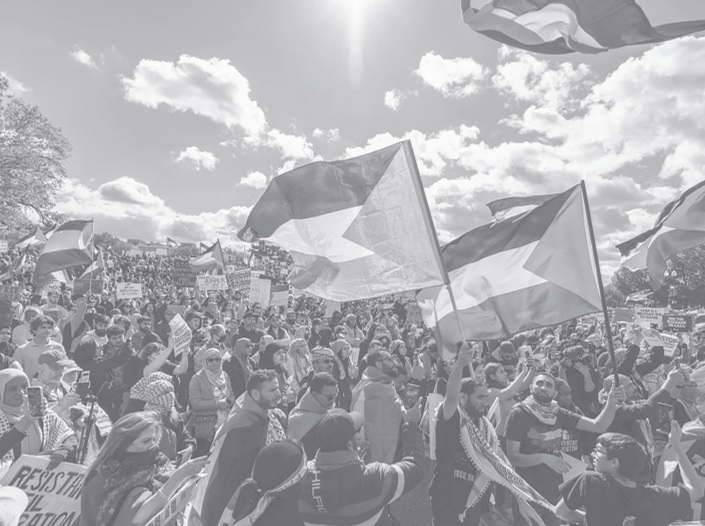
Today, Netanyahu and his fascist government continue the war of genocide in Gaza, while unleashing raids, colonial settlement expansion, and relentless assaults on the cities, villages across the West Bank, and East Jerusalem. They openly declare their plans to destroy the very idea of a Palestinian state, while the world continues to hide behind statements of condemnation and denunciation that mean nothing to Israel. No pretext remains to justify the ongoing silence and official international and regional inaction in failing to impose sanctions and a comprehensive boycott on the apartheid, genocidal regime of the state of occupation, Israel. This comes at a time when popular demonstrations are rising in the streets of every corner of the world, denouncing the occupation and the war crimes of the 21st century.