
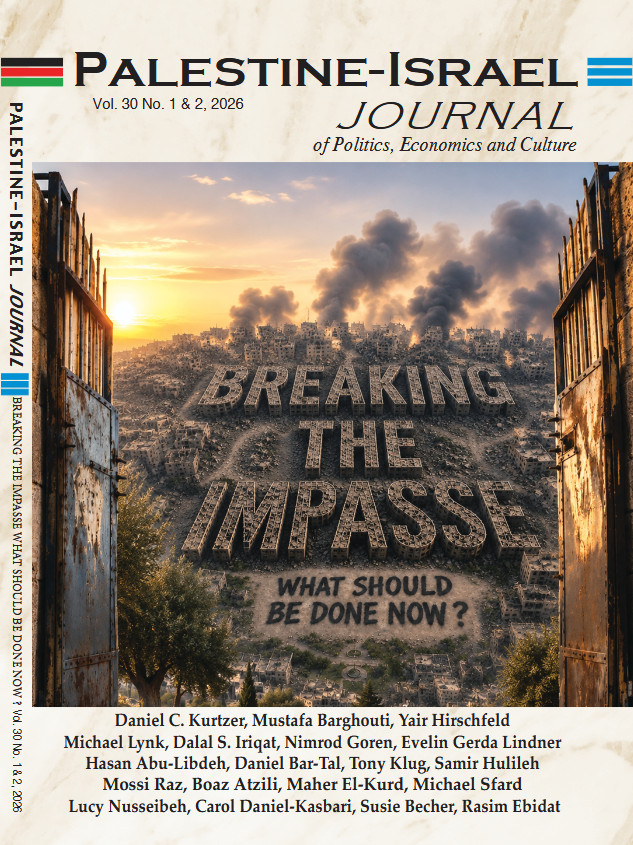
The October 7th attack and the subsequent retaliatory war in the Gaza Strip came against the backdrop of a period spanning more than 20 years since the beginning of this century. During this time the Israeli right wing grew stronger, the obligations of the
Oslo Accords were disregarded, the rights of the Palestinian people were denied, and Netanyahu’s leadership systematically weakened the Palestinian Authority (PA), which remained committed to Oslo. This was accompanied by attempts to create and cultivate a rival force to the PA in the Gaza Strip in order to sow discord and deepen the separation between the West Bank and Gaza, pave the way for the liquidation of the PA, solidify the annexation of the West Bank to Israel, and allow for coexistence with a Hamas-controlled enclave in Gaza that would live in harmony with Israel.
It can be argued that the most dangerous development the region has witnessed since 2002 in the context of the Israeli-Palestinian conflict is the growing power of the extreme Israeli messianic and nationalist right wing and its control over official decision-making, especially under the current government, which has been in power for four years. This right wing possesses the power to bring down or sustain the current Netanyahu-led government and thus feels emboldened to the point that its leaders feel no compunction about speaking of canceling the Oslo Accords, expelling or killing Palestinians, expanding Israel’s borders at the expense of neighboring countries’ territory, and realizing the dream of a Greater Israel from the Nile to the Euphrates.
On the political front, Israel has indeed succeeded in weakening the PA in the West Bank by besieging it materially and economically, drying up its funding sources, and engaging in character assassination of the PA intended to ruin its reputation and image in the eyes of its own people as well as regional and international public opinion. It has done so through the seizure of the PA’s tax revenues, harassment of its dignity and prestige, perpetration of attacks and raids within the areas under its control, and undermining the prestige of the Palestinian police and civilian personnel affiliated with the PA.
At the same time, Hamas in Gaza expanded its capabilities partly through external financing, including Qatari funds transferred with Israel’s approval. So, in 2018 Qatar delivered to Hamas monthly cash installments of $18 million per month. and from 2019 to 2021, $30 million per month — carried in suitcases entering through Ben Gurion Airport, alongside additional resources moving through tunnels from Sinai. Israel permitted these transfers as part of a policy aimed at weakening the PA in the West Bank, and strengthening Hamas as a political alternative to the PA, by stabilizing Gaza. Contrary to Israel intentions, Hamas used the period to reinforce both its governance structures and its military infrastructure. The suitcase‑cash system ended in late 2021 and was replaced by a UN‑supervised digital and banking mechanism.
In total, more than $1 billion in Qatari funds entered Gaza under Israeli oversight, reflecting an arrangement Israel believed it could manage for its own political interest, while Hamas leveraged to expand its capabilities against Israel.
Hamas illusion expected that inflicting a tactical defeat on Israel would allow it to present itself as a victorious leadership capable of extracting Palestinian rights through force. Through such a defeat, Hamas sought to position itself as the sole legitimate representative of the Palestinian people, eclipsing the national movement led by Fatah and establishing a pragmatic Islamic state dominated by Hamas the Muslim Brotherhood arm in Gaza.
...jpg)
Israel Has Crossed All Red Lines Since the October 7th
Attack Against this backdrop came the October 7th attack, a devastating blow and humiliation to Israel, during which approximately 1,200 Israelis were killed and another 251 kidnapped. This attack provided the extreme Israeli right wing with an opportunity to exploit the delusion that had gripped the minds of Hamas leaders and led to the catastrophe we are experiencing today. They used this delusion to incite violence against all Palestinians without distinction; to legitimize the killing of civilians, including women and children; and to call for the expulsion and displacement of Palestinians, giving them the choice between emigration, death, or becoming slaves to the Jews, as outlined in Minister Smotrich’s 2017 “Decisive Plan.” This also served to justify the destructive war Israel waged on the Gaza Strip, a war that violated internationally recognized principles of the laws of war, including the 1947 Geneva Conventions, particularly those concerning the protection of civilians during wartime.
According to these treaties, Israel crossed all red lines after failing to confine its confrontation with the resistance movements in the Gaza Strip, Hamas and Islamic Jihad, to the military sphere. It intensified its attacks on civilian targets and killed tens of thousands of innocent unarmed civilians, both to incite public opinion against Hamas and to pressure Hamas by holding it responsible for the civilian casualties, the massive destruction caused by the war, and the escalating humanitarian suffering resulting from the siege, indiscriminate bombing, and the almost daily displacement of civilians from one place to another. This displacement continues to occur amidst bombardment, killing, starvation, shortages of medical supplies and equipment, lack of food and water, and the spread of physical, psychological, and social diseases resulting from widespread chaos and the absence of public security and health services.
As all of this was happening, and in parallel with it, the Israeli illusion grew that the solution would be to force 2 million Palestinians in the Gaza Strip to migrate to the diaspora so that Israel could expand southward, swallow up the entire Gaza Strip, settle it, and exploit its beautiful beaches for tourism projects with U.S. and Gulf participation. This would happen on the ruins of the Palestinian people, whom they were planning to expel from the Gaza Strip after killing more than 73,000 of them, the vast majority of whom were children, women, and the elderly, and while destroying more than 80% of the urban area, including the destruction of the infrastructure for water, electricity, sanitation, schools, universities, medical clinics, hospitals, factories, mosques and churches, farms, and all the necessities of life. The intention was to make the Gaza Strip an uninhabitable for human beings, facilitate the implementation of the displacement and deportation plan, and complete the implementation of the Nakba that began in 1948 with the establishment of the State of Israel and with the aim of expelling the Palestinians from their homes, lands, and fields to neighboring countries and then to all parts of the world.
The Limitations of the Trump 20-Point Plan
After nearly two years of fighting, widespread death, destruction, and human suffering — the news and images of which reached every corner of the globe — the Trump administration began to grasp the reality that this senseless war was unsustainable. Its negative repercussions were beginning to influence international opinion, particularly among young people, including within the United States. This led President Donald Trump to launch his 20-point plan of 2025, imposing a ceasefire on Israel and Hamas. The agreement resulted in an exchange of all the remaining Israeli hostages and prisoners, including living Israelis and the bodies of those killed, in return for a partial release of some 2,000 Palestinian prisoners. It also established the “Yellow Line” that separates the areas of the Gaza Strip under Israeli control from those under Hamas control, leaving approximately 53% of the Gaza Strip in Israel’s hands.
However, Trump’s plan, whose primary objective was to achieve a ceasefire, lacked coherence, clear implementation mechanisms, and the necessary elements for effective execution. This was especially true given the coordination, bordering on complicity, between the Israeli Government and the U.S. administration. Furthermore, the outbreak of the conflict with Iran and the preoccupation of the administration and the world with this conflict — which threatens global economic stability and carries the potential to escalate into a regional and even international conflict — allowed Israel to continue its killing operations in Gaza, albeit at a reduced pace, and to further expand the territory under its control. Consequently, Israel has pushed the Yellow Line so that it now controls over 70% of the Gaza Strip, with the bombing and killing continuing daily. Approximately 1,300 civilians, most of them children, have been killed since the ceasefire was announced, and entire families have been wiped out from the civil registry.
In parallel with what is happening in Gaza, Netanyahu’ s government has given a free hand to the extremist Minister Smotrich to do as he pleases in the West Bank. He was given a ministerial portfolio in the Israeli Ministry of Defense, responsible for what is called the Coordinator of Government Activities in the Territories (COGAT) in the West Bank, as well as the socalled Civil Administration though it is military. Smotrich has appointed teams of extremist settlers to positions in these departments, and their sole focus has been on how to expand existing settlements, create new settlements (outposts), grab Palestinian homes even in Area B and A which are under the constituency of the PA, encouraging settlers terrorist attacks on Palestinian villages and towns under the protection of the Settlers Militias in Israeli army uniform known as Haganah Merhabit, including arson, theft of livestock, forcible seizure of property, and even murder.
Undoubtedly, the natural consequence of all these prevailing conditions in the Gaza Strip and the West Bank is pushing the Palestinians to selfdefense response which will be used as a justification to more settlers’ terror and violence.
The loss of hope of reaching a political solution to the conflict and the disappearance of any chance of implementing a “two-state solution,” is leading to an increase in hatred and animosity between the two sides, with each demonizing the other and portraying every Palestinian as a terrorist and every Israeli Jew as a racist, extremist settler.
Conclusion
In light of this situation, two things are essential.
First, there must be acknowledgment that the Israeli-Palestinian conflict is a political one and that neither side can annihilate, expel, or erase the other’s existence. Both peoples are here to stay, and war and violence from both sides have not and will not bring peace, security, or stability to either. This has been proven by decades of bloody conflict that have yielded no positive results.
Second, building on the previous point, we must ask: Since war and violence will not bring a solution, what should be done? The answer is complex and multifaceted, requiring action on several levels and layers. It includes defusing and reducing the hatred and animosity that have been built between the two sides and curbing the influence of racist and extremist figures like Smotrich and Ben-Gvir — many of whom have reached Knesset seats and positions of power — and their counterparts on the Palestinian side. It also involves purging the toxic atmosphere that has built up between the two sides and initiating a process of building hope, trust, and a desire for reconciliation, while embracing the concept of transitional justice as a means to help clear the air. All of this requires, first and foremost, an immediate end to the ongoing humanitarian catastrophe in the Gaza Strip by the withdrawal of the Israeli army from Gaza Strip to pre-October 7 borders, lifting the siege and allowing the entry of medical, food, and construction materials and equipment. It also necessitates restoring public safety and putting an end to the chaos and lawlessness, and promoting a Palestinian political leadership alternative to Hamas in full harmony and coordination with the PA. This must be done in parallel with ending the proliferation of weapons and establishing a single, official, national armed force under a unified Palestinian authority that encompasses both the Gaza Strip and the West Bank in recognition of the unity of the Palestinian land and people. Furthermore, it requires curbing settlement activity and the violent attacks of settlers in the West Bank and occupied Jerusalem, halting the politicization of the Israeli army and its transformation into a tool in the hands of extremist religious fundamentalism that denies the right of others to life. Simultaneously, it is essential to strengthen and support the Palestinian national movement and neutralize any entity with a non-Palestinian national agenda. The sole objective that should guide the region’s agenda is ending the Israeli occupation and recognizing the Palestinian people’s right to self-determination, and establish their independent, sovereign state on their national soil within the June 4, 1967 borders, with East Jerusalem as its capital. This also requires resolving all outstanding issues, including the Palestinian refugee problem, in a manner that does not infringe upon their rights or preclude the existence of the State of Israel alongside the State of Palestine.
We stand today on the cusp of elections in Israel at the end of October and in Palestine at the end of November. Hopefully they will be free and democratic elections on both sides with no intimidation or undermining of the electoral process or generating tensions and wars to prevent holding elections.
Undoubtedly, these will be pivotal, historic elections that will determine the future course of this conflict, either leading to further bloodshed, violence, and destruction or to a completely opposite path.