
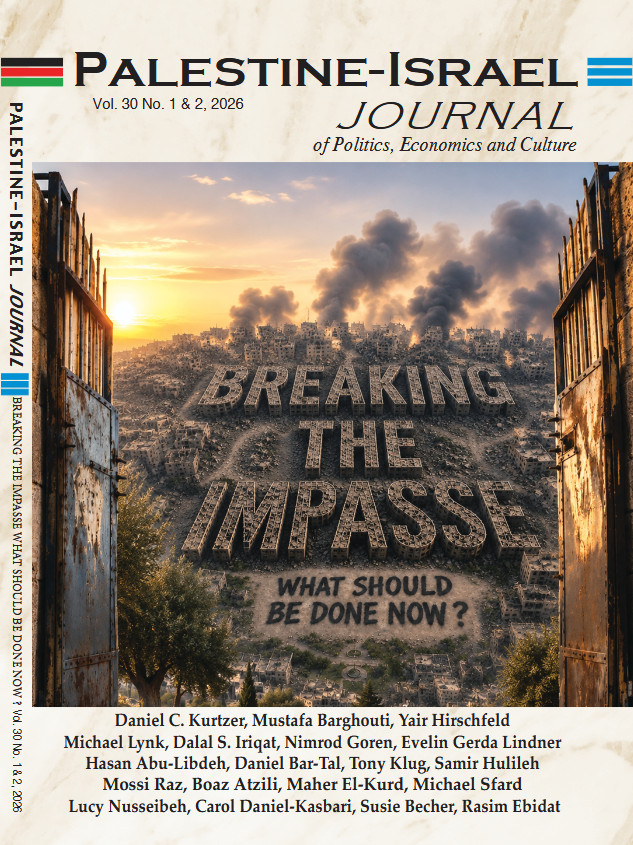
…any serious attempt to answer “what should be done now” must begin with a sober acknowledgment: wars and violence have not, and will not, resolve this conflict. They have instead entrenched it. The current moment — particularly in the aftermath of the devastating war on Gaza — has exposed not only the asymmetry of power but also the asymmetry of narratives, where one side’s security is often framed as incompatible with the other’s existence. This is precisely where the challenge lies.
One of the greatest casualties of the past decades has been the idea of Israeli-Palestinian engagement itself. As the political process deteriorated, so too did confidence in people-to-people initiatives. Many Palestinians came to view donor-funded dialogue programs as disconnected from reality, particularly when they failed to address the structural asymmetries of occupation, power, and rights. Critics argued that dialogue without justice risked normalizing an unacceptable status quo rather than transforming it.
This criticism should not be dismissed. Indeed, many dialogue projects were designed around coexistence rather than conflict transformation, prioritizing interpersonal understanding while avoiding the political questions at the heart of the conflict. As settlements expanded, violence intensified, and Palestinian aspirations for self-determination remained unfulfilled, such initiatives often appeared detached from the lived experiences of those most affected by the conflict.
Yet rejecting superficial engagement should not mean abandoning engagement altogether.
If there is one lesson from the darkest periods of the conflict, it is that some Palestinians and Israelis have continued to defend the principles of peace, equality, and mutual recognition despite enormous personal, political, and social costs. These are not individuals motivated by donor priorities or professional peacebuilding industries. They are people who have remained committed to justice even when doing so brought isolation from their own communities, accusations of betrayal, and profound personal loss.
The future of peacebuilding must therefore move beyond symbolic coexistence projects and invest instead in what might be called principled political engagement. Such engagement is not based on denying power asymmetries or avoiding difficult conversations. It is rooted in an explicit commitment to human rights, international law, equality, and the recognition of both peoples’ collective rights. It acknowledges occupation, insecurity, trauma, and historical narratives without reducing either side to those experiences alone.
Importantly, the most credible partners in this endeavour are those who have demonstrated consistency over time. They are Palestinians who have continued to advocate diplomacy, nonviolence, and political solutions despite dispossession and war. They are Israelis who have challenged occupation, opposed dehumanization, and defended Palestinian rights even when such positions became politically unpopular. These voices exist, but they are often marginalized by the rise of extremism and the incentives of polarized politics.
Political breakthroughs rarely emerge solely from elite negotiations. Durable peace requires constituencies capable of sustaining difficult compromises and defending them against radical opposition. Research on peacebuilding repeatedly demonstrates that conflict transformation depends not only on agreements between leaders but also on the creation of social and political infrastructures that support reconciliation, accountability, and nonviolence. Peace makers on leading political parties must bless the process and be involved in it, second track donor-oriented path alone is not sustainably fruitful.
For this reason, a future political strategy should actively support principled Palestinian-Israeli networks that are grounded in their respective political realities rather than detached from them. These actors should not replace formal diplomacy, but they can complement it by rebuilding trust, challenging dehumanization, and demonstrating that engagement does not require surrendering identity, rights, or historical memory.
In a region increasingly dominated by fear and absolutist narratives, the most radical act may be neither dialogue for its own sake nor separation from the other, but the deliberate construction of political relationships rooted in dignity, equality, and accountability. Peace will not emerge from pretending that the conflict does not exist. It will emerge from engaging it honestly; while refusing to abandon the belief that both peoples deserve freedom, security, and self-determination.
The challenge is no longer how to create dialogue, but how to elevate and empower those Palestinians and Israelis who have consistently chosen principle over polarization, justice over domination, and political courage over ideological conformity.
What Should Be Done Now? Reclaiming Humanity and Rebuilding the Political Horizon
The question “What should be done now?” is no longer a matter of policy preference or diplomatic sequencing. It is a question of urgency, responsibility, and moral clarity. The Israeli-Palestinian conflict has reached a stage where the cost of inaction is no longer measured in stalled negotiations or diplomatic setbacks, but in the systematic erosion of humanity itself. The deepening cycles of violence, the normalization of dehumanization, and the fragmentation of political agency have collectively produced a reality where the absence of a political horizon is not incidental — it is structural.
In this context, any serious attempt to answer “what should be done now” must begin with a sober acknowledgment: wars and violence have not, and will not, resolve this conflict. They have instead entrenched it. The current moment — particularly in the aftermath of the devastating war on Gaza — has exposed not only the asymmetry of power but also the asymmetry of narratives, where one side’s security is often framed as incompatible with the other’s existence. This is precisely where the challenge lies.
From Dehumanization to Political Paralysis
At the heart of the current impasse is the systematic dehumanization of the “other.” This is not merely rhetorical; it is institutional, legal, and deeply embedded in policy frameworks. Dehumanization allows for the justification of excessive force, the normalization of collective punishment, and the dismissal of civilian suffering as collateral or inevitable.
For Palestinians, this dehumanization is experienced through occupation, displacement, and denial of basic rights. For Israelis, it manifests in a securitized worldview that reduces Palestinians to perpetual threats rather than political actors with legitimate rights. These mutually reinforcing narratives create what can be described as “conflicted threat perceptions,” where each side’s sense of insecurity justifies policies that deepen the insecurity of the other.
Breaking this cycle requires more than confidence-building measures. It requires a deliberate and structured effort to rehumanize the conflict. This begins with language, but it must extend to policy. International actors, media institutions, and political leaders must move beyond neutral descriptions of “conflict” and address the asymmetries and structural realities that sustain it.
The Crisis of the Political Track
The failure of the political process is not simply due to the absence of negotiations. It is rooted in the erosion of the very foundations upon which a political solution can be built. The expansion of settlements, the fragmentation of Palestinian territory, and the weakening of Palestinian political institutions have collectively undermined the viability of a two-state solution.
Yet, paradoxically, the absence of a credible alternative makes the two-state framework more necessary than ever — not as a rhetorical commitment, but as a structured and enforced political outcome. The question is no longer whether a two-state solution is theoretically possible, but whether the international community is willing to take the necessary steps to make it politically inevitable.
This requires a shift from a process-based approach to an outcome-based strategy. For decades, diplomacy has focused on managing negotiations rather than delivering results. This has allowed for the perpetuation of the status quo under the guise of peace efforts. What is needed now is a redefinition of diplomacy itself — from facilitation to enforcement.
Re-centering International Law and Accountability
A credible political track cannot exist without accountability. International law has been consistently invoked but rarely enforced in the Israeli-Palestinian context. This selective application has not only undermined the credibility of international institutions but has also emboldened violations.
The advisory opinion of the International Court of Justice (ICJ) reaffirming the illegality of the occupation provides a critical legal foundation. However, legal recognition without political action risks becoming symbolic. The next step must involve translating legal findings into political consequences. This includes sanctions, conditionality in bilateral agreements, and the activation of accountability mechanisms within international institutions.
Moreover, recognition of the State of Palestine should no longer be treated as a symbolic gesture. It must be part of a broader strategy to rebalance the political equation. Recognition is not the end of the process — it is the beginning of a new framework where Palestine is engaged as a sovereign actor rather than a humanitarian case.
Palestinian Agency and Internal Renewal
While external actors play a critical role, the Palestinian political system must also undergo a process of renewal. The fragmentation between Gaza and the West Bank, the absence of elections, and the erosion of public trust have weakened Palestinian agency at a critical moment.
Rebuilding this agency requires a commitment to democratic processes, inclusive governance, and the integration of youth and women into decision-making structures. The Palestinian national movement must transition from a reactive posture to a proactive strategy that leverages international law, digital diplomacy, and global civil society networks.
Importantly, Gaza must be reintegrated into the political framework not as a humanitarian exception, but as an integral part of the Palestinian state. Any reconstruction effort that bypasses Palestinian sovereignty risks entrenching division rather than resolving it.
The Role of Regional and Global Actors
The regional dimension of the conflict cannot be ignored. Recent normalization agreements have reshaped the geopolitical landscape, but they have also highlighted a critical lesson: peace agreements that exclude Palestinians are inherently unstable.
Regional actors must move beyond transactional diplomacy and adopt a principled approach that links normalization to tangible progress on Palestinian rights. Similarly, global powers must recognize that managing the conflict is no longer sufficient. Stability in the region is contingent upon resolving its core injustice.
This requires coordinated international action, including the revival of a multilateral framework that includes not only traditional mediators but also emerging powers and regional stakeholders. The goal should not be to restart negotiations for their own sake, but to create a structured pathway toward a defined political outcome.
From Violence to Non-Violent Political Strategy
The repeated cycles of violence have demonstrated their futility. They have neither delivered security for Israelis nor freedom for Palestinians. Transitioning to non-violent strategies is not a moral luxury — it is a strategic necessity.
For Palestinians, this involves strengthening legal and diplomatic tools, investing in global advocacy, and building alliances that translate moral support into political pressure. For Israelis, it requires a re-evaluation of security doctrines that prioritize military dominance over political resolution.
Non-violence, however, cannot succeed in a vacuum. It must be supported by international frameworks that reward compliance and penalize violations. Without this, calls for non-violence risk being perceived as asymmetrical demands placed on the weaker party.
Reimagining Hope as Policy
Hope is often treated as an abstract concept, detached from policy realities. Yet, in the context of the Israeli-Palestinian conflict, hope must be operationalized. It must be embedded in institutions, reflected in policies, and reinforced through tangible changes on the ground.
Promoting hope requires restoring credibility to the idea that a political solution is possible. This means setting clear timelines, defining benchmarks, and ensuring accountability for progress. It also requires amplifying voices that challenge dehumanization and advocate for coexistence.
Educational systems, media narratives, and civil society initiatives must play a role in reshaping perceptions. The next generation must be equipped not only with historical awareness but also with the tools to imagine and build a different future, all this applies to both sides.
Conclusion: From Managing Conflict to Leading Transformation
The current moment demands a shift from conflict management to conflict termination. This is not a rhetorical adjustment — it is a strategic imperative. The status quo is not sustainable, and incremental approaches are no longer sufficient.
“What should be done now” is, therefore, not a single action but a coordinated set of steps:
• Rehumanize the narrative
• Enforce international law
• Empower Left on both sides
• Restore Palestinian agency
• Redefine diplomacy as outcome-driven
• Transition from violence to political strategy
Ultimately, the question is not whether a better future is possible, but whether there is sufficient political will to pursue it. The responsibility lies not only with leaders but with institutions, societies, and the international
community as a whole.
The path forward is difficult, but it is not impossible. What is required is clarity of purpose, courage of leadership, and a collective commitment to justice — not as an aspiration, but as a foundation for peace.